 By
Quick answer
Who treats obstructive sleep apnea in Dubai, and how is it diagnosed?
Dr. Muhammad Jabbr is a Consultant ENT (ear, nose and throat) specialist who diagnoses and treats obstructive sleep apnea (OSA). He sees patients at Medcare Hospital Al Safa, Dubai. In OSA, the throat narrows or closes again and again during sleep. Snoring and tiredness alone cannot confirm it. Tests show whether you have OSA, how severe it is and where your airway closes. If you doze off while driving, book a visit soon. Do not drive when you feel drowsy.
Loud snoring and tired mornings can point to many things. Only proper tests can show whether you have obstructive sleep apnea (OSA). If you are looking for an obstructive sleep apnea specialist in Dubai, it helps to know what each test does.
Dr. Muhammad Jabbr, Consultant ENT and Head & Neck Surgeon at Medcare Hospital, Al Safa, uses a step-by-step check to find out whether you have OSA and where your airway narrows. Over more than 20 years in practice, he has carried out more than 3,000 ENT procedures. For a careful check of the whole airway, he is one of the best ENT surgeons you can see in Dubai.
Why does sleep apnea need proper testing?
In OSA, the throat narrows or closes again and again during sleep. Breathing becomes very shallow or stops for ten seconds or more, until the brain briefly wakes you, often without you knowing.
Two people can snore just as loudly, yet one has no apnea and the other has severe OSA. Snoring and tiredness alone cannot tell them apart. Testing answers three questions:
- Do you have OSA at all?
- How severe is it?
- Where does it happen? A blocked nose can add to the problem, but the collapse itself happens in the throat, often at more than one level.
Step 1: Your sleep history and questionnaires
Your first visit begins with questions. Expect to talk about your snoring, any breathing pauses a partner has seen, and how sleepy you feel during the day. Weight changes, blood pressure, medicines, alcohol and smoking are covered too.
You may be asked to fill in short questionnaires. Common ones include:
- The Epworth Sleepiness Scale. It scores how likely you are to doze off in everyday situations, such as reading or sitting in traffic.
- The STOP-BANG questionnaire. Eight quick questions, such as snoring, blood pressure, age and neck size, estimate your risk.
These forms do not diagnose OSA on their own. They help decide which test you need and how soon. For more on this first stage, see our sleep apnea evaluation and diagnosis page.
Step 2: A careful look at your airway
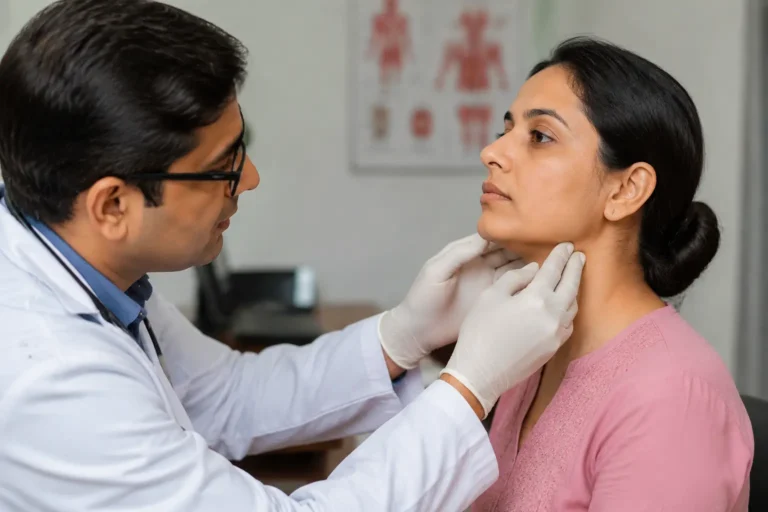
Dr. Jabbr then examines the parts of your airway that may narrow at night:
- Nose: a bent septum, swollen turbinates, polyps or allergy swelling.
- Mouth and throat: the size of your tonsils, a long soft palate or uvula, and how much of the throat is hidden by the tongue.
- Jaw and bite: a lower jaw that sits further back can push the tongue towards the throat.
- Neck size and body weight: both affect how easily the airway collapses.
The check usually includes a nasal endoscopy. After a numbing spray, a slim camera on a flexible tube is passed into one nostril. Within a few minutes, it shows the back of the nose, the throat and the voice box on a screen.
This awake view helps, but throat muscles relax much more in sleep. That is why a sleep study, and sometimes DISE, comes next.
Step 3: Home sleep test or sleep study in a lab?
A sleep study is the test that confirms OSA. There are two main types.
Home sleep apnea test
You take a small device home and wear it for one night in your own bed. It usually records your airflow, chest movement, oxygen level and pulse. It suits adults whose history strongly suggests moderate or severe OSA and who have no major heart, lung or nerve problems.
In-lab polysomnography
You spend a night in a sleep unit. Small sensors on your head, face, chest and legs record brain waves, eye and leg movements, heart rhythm, breathing and oxygen. This full study is the usual test for children. In adults, it may be advised if:
- a home test was normal, but your symptoms are still strong;
- you have heart or lung disease, or a nerve or muscle condition;
- another sleep problem, such as restless legs or unusual night-time behaviour, is suspected.
What does your AHI score mean?
The main number in a sleep study report is the apnea-hypopnea index (AHI). It counts how many times per hour your breathing stops (apnea) or becomes very shallow (hypopnea).
- Under 5: normal in adults.
- 5 to 14: mild OSA.
- 15 to 29: moderate OSA.
- 30 or more: severe OSA.
These grades are for adults. Children are scored with stricter limits, so even a low number can matter.
The AHI is not the whole story. Your report also shows how low your oxygen dropped, how long it stayed low and whether events are worse when you lie on your back.
Your symptoms count as well. Mild OSA with strong daytime sleepiness, especially while driving, still needs prompt treatment.
Step 4: DISE – watching the airway while you sleep
A sleep study tells you how much apnea you have. It does not show where the airway closes. For that, some patients need drug-induced sleep endoscopy (DISE). It is done only after a sleep study has confirmed OSA.
During DISE, an anaesthetist gives you a measured sedative to bring on a sleep-like state. Dr. Jabbr then passes a thin camera through the nose and watches how your airway behaves as you snore and breathe. The test is short, and most people go home the same day.
DISE looks at four main levels:
- the soft palate and uvula;
- the side walls of the throat and the tonsils;
- the base of the tongue;
- the epiglottis, the flap above the voice box.
It also shows the shape of the collapse, for example front-to-back or a ring-like narrowing all around. DISE is not needed for everyone. It is mainly used when surgery or a mouth device is being considered, or when CPAP has not worked for you.
How do test results shape your treatment plan?
Dr. Jabbr explains your results in plain words. The plan depends on severity, the site of blockage, your general health and your wishes. Options may include:
- Lifestyle steps such as weight loss, less alcohol at night and sleeping on your side.
- Positive airway pressure, often the first choice for moderate or severe OSA. Our CPAP therapy page explains how it works.
- Treating a blocked nose. On its own, this rarely clears OSA, but it can make CPAP more comfortable to use.
- An oral appliance made with a dentist, which moves the lower jaw forward. It is mostly used for mild to moderate OSA, or when CPAP does not suit you.
- Surgery for carefully chosen patients, aimed at the levels found on DISE. When more than one level is involved, multi-level sleep apnea surgery may be discussed.
No treatment can promise a set result, but a clear diagnosis helps you choose the option most likely to work for you.
Choosing an obstructive sleep apnea specialist in Dubai
A good assessment looks at the whole airway, from nose to voice box. Ask whether the specialist examines the airway with a camera, arranges the right type of sleep study and offers DISE when it is needed.
Dr. Jabbr's training includes an MD and MS, the DOHNS (England), and both the European and Arab Board qualifications in ORL-HNS. He treats adults as well as children.
Is it safe to wait for your test date?
Most people can wait for a planned sleep study. Some cannot:
- Nodding off at the wheel, even for a moment. Book a visit soon, and do not drive on days you feel drowsy.
- A child who snores and has breathing pauses, struggles to breathe in sleep or is not growing well. Ask for an earlier review.
- Chest pain, breathlessness while awake or blue lips. These need emergency care straight away, not a clinic visit.
Book an appointment
You can see Dr. Jabbr at the ENT Department, Medcare Hospital, Hadiqa Street, Al Safa 1, Dubai. Book your assessment online or phone +971 52 751 7811. Bring any earlier sleep study report with you.
Frequently Asked Questions
Can a child have a sleep study?
Yes. Children usually have a full study in a sleep unit, scored with child rules. Large tonsils and adenoids are a common cause, so the ENT examination matters too.
Is a home sleep test as accurate as a lab study?
For many adults with clear signs of moderate or severe OSA, a home test is reliable. It can miss milder cases because it does not record sleep itself. If it is normal but symptoms continue, a lab study may be advised.
Is DISE the same as a general anaesthetic?
No. DISE uses lighter sedation that aims to mimic natural sleep. It is not an exact copy, so the findings are read alongside your sleep study. An anaesthetist monitors you throughout. Fasting rules are given in advance, and an adult should take you home afterwards.
Will I need a repeat sleep study?
Sometimes. A repeat test may be advised if your weight changes a lot, if symptoms come back, or after surgery or a mouth device to check how well it works.
Should I stop my usual medicines before testing?
Do not stop any medicine on your own. Tell your doctor about everything you take, especially sleeping tablets, sedatives and pain medicines. You will be told what to do before the test.
In short: from tests to a clear plan
Snoring tells you something may be wrong. Tests tell you what it is and where it happens. With that picture, Dr. Muhammad Jabbr can help you choose a plan that fits your airway and your daily life.