 By
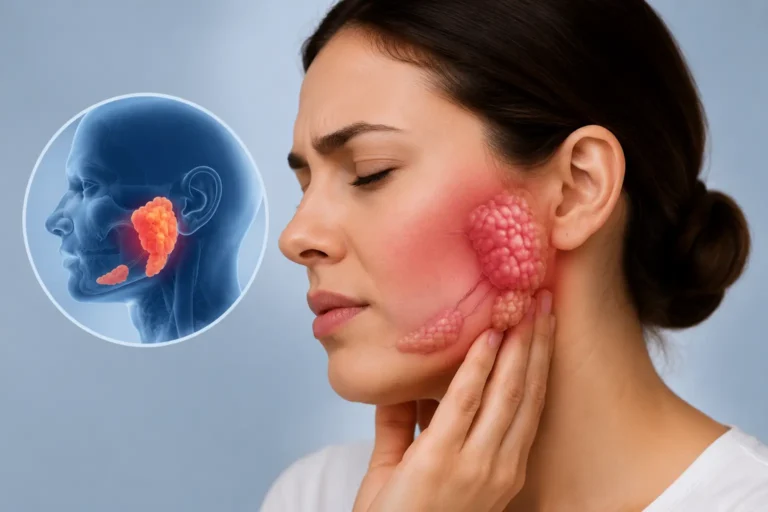
By A salivary stone is tiny, but it can turn every meal into a painful event. You start to eat, the gland under your jaw or in your cheek swells, and it aches until the swelling slowly goes down. If this keeps happening, you may be looking for a salivary stone removal specialist in Dubai.
Most stones do not need a big operation. Care goes step by step. Home measures come first. If the stone stays, it can often be taken out through the mouth or with a very thin camera called a sialendoscope. Removing the whole gland is kept for the few people whose stones keep coming back.
Dr. Muhammad Jabbr is a Consultant ENT and Head & Neck Surgeon at Medcare Hospital, Al Safa, and one of the best doctors in Dubai to see for a blocked salivary gland.
What is a salivary stone, and where does it get stuck?
A salivary stone (sialolithiasis) is a small, hard lump made mostly of calcium salts. It builds up slowly inside a gland or inside the thin tube, or duct, that carries saliva into your mouth.
Most stones are found in the submandibular gland, under the jaw. Its saliva is fairly thick and has to travel upward along a long duct, which gives minerals time to settle. Fewer stones form in the parotid gland, in front of the ear. Stones in the small gland under the tongue are rare.
The size of the stone and where it sits shape the plan. A small stone near the duct opening is often easy to reach. A large one deep in the gland is harder.
Which scans show where the stone is?
Before any removal, the stone needs to be found and measured. Dr. Jabbr will ask how often the swelling happens, then examine the gland and gently feel along the floor of your mouth.
- Ultrasound – quick and painless. It shows most stones, their size and the state of the gland.
- CT scan – shows calcium very clearly. It helps when there may be more than one stone.
- MRI or sialography – used in some cases to show the shape of the duct and any narrowing.
Step 1: Can a salivary stone come out on its own?
Yes, small stones sometimes do. So care often starts with simple measures that keep saliva moving and help push the stone forward:
- Drink water often. Thin, watery saliva flows more easily.
- Try sugar-free sour sweets. A sour taste makes the gland pump out a rush of saliva, which may wash a small stone out. If the pain gets much worse, stop and tell your doctor.
- Massage the gland. Press gently along the path of the duct, toward its opening in the mouth.
- Use a warm compress. A warm cloth on the swelling can ease the ache and help the gland drain.
If the gland is infected, you may also need antibiotics. These ease the symptoms, but they do not dissolve the stone.
Step 2: Removing the stone through the mouth
When a stone sits near the front of the submandibular duct, it can often be taken out from inside the mouth, with no cut on the skin.
The floor of the mouth is numbed with local anaesthetic. A small cut is made in the lining over the stone, and the stone is lifted out. The opening may heal by itself or be closed with a few dissolving stitches. You usually go home the same day.
A stone further back, near where the duct meets the gland, can sometimes be removed the same way under general anaesthetic. The surgeon takes extra care here, because the nerve that gives feeling to the tongue runs close to the duct.
Recovery: the area may be sore for a few days. Soft, cool foods and gentle rinsing after meals help. Brief tongue numbness can follow a deeper removal. Now and then the duct narrows as it heals, so report any return of mealtime swelling.
Step 3: Sialendoscopy – a tiny camera inside the duct
Sialendoscopy uses a very thin scope passed through the natural opening of the duct inside the mouth. The surgeon looks along the duct on a screen for stones or narrowing.
A small stone can often be caught in a tiny wire basket and drawn out. A larger one may first need to be broken into pieces. In selected cases this is done with a laser fibre passed through the scope, one of several laser techniques used in ENT surgery.
If a stone is too big for the scope alone, a combined approach may be used. The scope finds the stone and a small cut lets the surgeon lift it out. For the gland under the jaw, this cut is inside the mouth. For a parotid stone, a small skin cut in front of the ear is sometimes needed. The aim is to keep the gland working.
Recovery: the gland often swells for a day or two, because salt water is used to open the duct. A tiny soft tube, called a stent, is sometimes left in the duct for a few weeks to help it heal open.
Step 4: When does the whole gland need removing?
Most people never need this step. Gland removal is usually only considered when stones keep coming back, when a large stone sits deep in the gland out of reach, or when repeated infections have left the gland working poorly.
For the gland under the jaw, this is done through a cut in a natural skin crease of the neck. The full operation is covered on our submandibular gland surgery in Dubai page. Removing the parotid gland for stones is uncommon and more delicate, as explained on the parotid gland surgery page.
These operations sit close to important nerves, so they belong with a trained head and neck surgeon in Dubai.
How can you lower the chance of a new stone?
A stone can come back, especially if the reason it formed is still there. A few habits may help:
- Drink water steadily through the day, not only when thirsty.
- Keep your mouth clean with regular brushing and rinsing.
- Massage the gland now and then, as your doctor showed you.
- Ask whether any of your medicines dry your mouth. Never stop one without advice.
- Come back early if mealtime swelling returns. A small new stone is easier to treat.
When should you get urgent help?
A blocked gland can become infected, and an infection can spread or form a pocket of pus (an abscess). See a doctor the same day if you have:
- A high fever and a gland that is growing, red and hot.
- Swelling that spreads down the neck.
Go to an emergency department straight away if you have any trouble breathing, or swelling under the tongue that makes it hard to swallow or open your mouth.
What should you look for in a salivary stone removal specialist in Dubai?
Look for a doctor who first finds where the stone sits, then starts with the simplest option likely to work. Dr. Muhammad Jabbr brings:
- Specialist training: MD, MS, DOHNS (England), the European Board ORL-HNS and the Arab Board ORL-HNS.
- Experience: more than 20 years in ENT and head and neck surgery, and more than 3,000 ENT procedures.
- Clear choices: he explains each option, from home care to surgery, and why one may suit your stone better.
- Patient feedback: rated 4.9 on Google across 406 reviews.
Book an appointment
If a gland swells each time you eat, it is worth an early check. Dr. Jabbr sees patients at the ENT Department of Medcare Hospital on Hadiqa Street, Al Safa 1, Dubai.
Book online with Dr. Muhammad Jabbr or call +971 52 751 7811.
Frequently Asked Questions
How long can I wait before a salivary stone is removed?
If symptoms are mild and there is no infection, home measures are often tried for a few weeks. If swelling keeps returning or the gland gets infected, do not wait too long. Repeated blockage can harm the gland.
Is salivary stone removal done under local or general anaesthetic?
It depends on the stone and the method. A stone near the duct opening is often removed under local anaesthetic. Sialendoscopy may be done under local or general anaesthetic. Deeper stones and gland removal usually need general anaesthetic.
Will I have a scar after the stone is taken out?
Removal through the mouth and most sialendoscopy procedures leave no skin scar. A small scar is possible if a parotid stone needs a combined approach, or if the gland is removed.
Can medicine dissolve a salivary stone?
No tablet reliably dissolves a salivary stone. Antibiotics treat infection and pain relief eases discomfort. The stone itself either passes or is removed.
How soon can I eat normally after sialendoscopy?
Most people can eat soft, cool food the same day and return to a normal diet over a few days.
Will I need time off work after a stone is removed?
It depends on the procedure. After a quick removal under local anaesthetic, many people return to desk work within a day or two. After general anaesthetic, a few days off is common.
Your next step
Most salivary stones can be handled with simple steps or a small procedure, and the gland can often be kept. Gland removal is a last step, not a first one. If mealtime swelling has become part of your life, Dr. Muhammad Jabbr can find where the stone sits and which step makes sense for you.