 By
Quick answer
Who treats parotid tumors in Dubai, and when should you see a doctor?
Dr. Muhammad Jabbr is a Consultant ENT (ear, nose and throat) and Head and Neck Surgeon who checks and treats parotid tumors. He sees patients at Medcare Hospital Al Safa, Dubai. The parotid is the largest saliva gland, found in front of the ear. Most lumps here are harmless, but every new lump should be checked. See him within days if the lump hurts or grows fast, or your face becomes weak. Sudden facial weakness needs urgent medical help.
You touch your face and find a small, firm bump just in front of your ear, or near the angle of your jaw. It does not hurt. It may have been there for weeks. Most people in this position worry about one thing: is it cancer? A visit to a parotid tumor specialist in Dubai can often give you a clear answer with a few simple tests.
Here is some comfort to start with: far more parotid lumps are harmless than harmful. Still, a new lump in this spot should never be left unchecked. This guide covers the usual types, the warning signs and the tests.
Dr. Muhammad Jabbr assesses parotid lumps as part of his daily work as a Consultant ENT and Head & Neck Surgeon in Al Safa. Many patients regard him as one of the best doctors in Dubai to look into this kind of lump.
Where is the parotid gland, and why do lumps form there?
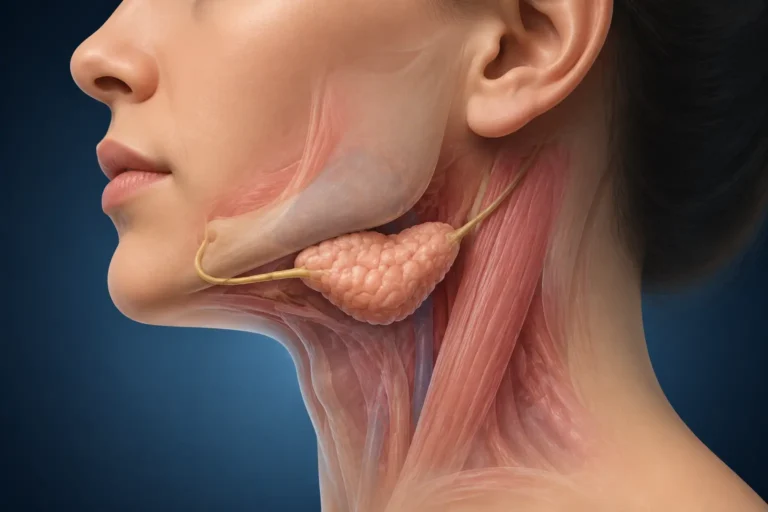
You have two parotid glands, one on each side of your face. They are the biggest of your salivary glands. Each one lies in front of the ear canal, and its lower end reaches just below the ear lobe.
The parotid has one special feature. The facial nerve passes through it on its way to the muscles you use to smile, blink and frown. Inside the gland, this nerve divides it into a larger outer part and a smaller deep part. That is why any lump here needs careful planning.
A "tumour" is any new growth of cells, whether harmless or harmful. Some lumps here are not tumours at all, but a swollen lymph node or a small cyst.
Pleomorphic adenoma, Warthin tumour or cancer: what could the lump be?
In most people, a parotid tumour is benign: it stays in the gland and does not travel elsewhere. These are the types you may hear about.
Pleomorphic adenoma: the type doctors see most
Doctors find this parotid tumour more often than any other. It is benign, and usually feels smooth, firm and painless. It grows very slowly. Over many years, it carries a small risk of part of it changing into cancer. It can grow back if tiny pieces stay behind after surgery.
Warthin tumour: often linked to smoking
This is the next most common type. It mostly appears in older adults, and far more often in smokers. It can feel soft or rubbery. It can appear in both glands, or as more than one lump in the same gland. Warthin tumours very rarely become cancer.
The rarer cancers
A smaller number of parotid lumps are malignant (cancer). Names you may hear include mucoepidermoid carcinoma, adenoid cystic carcinoma and acinic cell carcinoma. A parotid lump can also be a lymph node affected by skin cancer of the face or scalp, or by lymphoma.
Facial weakness, pain or fast growth: what do these signs mean?
Benign parotid lumps are usually painless and slow. The signs below do not prove cancer, but they mean you should be seen within days, not months:
- Weakness of the face on the same side, such as trouble closing the eye, a drooping corner of the mouth or an uneven smile.
- Pain in the lump, or numbness or tingling of the face or ear.
- Fast growth over a few weeks.
- A lump that feels hard and fixed, so it does not move when you press it, or skin over it that becomes tied down or breaks open.
- New lumps lower down in the neck as well.
Sudden facial weakness needs urgent medical help straight away. It can also come from Bell's palsy or a stroke, and a stroke is an emergency.
For lumps lower down the neck, see our page on the neck lump specialist in Dubai.
How does a parotid tumor specialist in Dubai find out what the lump is?
The aim is to learn the lump's type, its size and how close it sits to the facial nerve.
History and examination
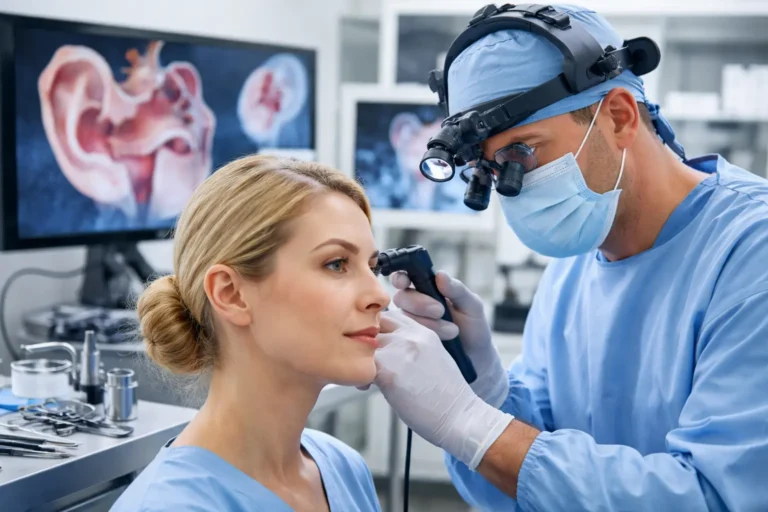
Your doctor will ask when the lump appeared and whether it has changed. They will feel the lump and your neck. To test the facial nerve, they will ask you to shut your eyes tightly, raise your eyebrows and smile. They will also look inside your mouth, because a tumour in the deep part of the gland can push the tonsil or soft palate inwards.
Ultrasound scan
An ultrasound is often the first scan. A small probe glides over the skin, and no X-rays are involved. It shows how big the lump is, whether it is solid or fluid, and whether nearby lymph nodes look normal.
Needle biopsy (FNA or core biopsy)
Next, a thin needle is passed into the lump, often while the doctor watches on the ultrasound screen. This is called fine needle aspiration, or FNA. The cells are then studied under a microscope. In some cases a slightly thicker needle takes a thin strip of tissue instead. The result often shows if the lump is benign or malignant. If the sample is too small or unclear, the test may need repeating.
Doctors usually avoid cutting into a parotid lump just to take a sample. An open cut can spill tumour cells and put the facial nerve at risk.
MRI or CT scan
An MRI scan gives a detailed picture of the whole gland. It shows if the lump reaches the deep part of the gland and whether it looks more aggressive. A CT scan may be used in some cases.
Why is removal often advised, even for a benign lump?
Being told to remove a lump that is not cancer can feel odd. Here is why:
- Most benign tumours slowly get bigger. A pleomorphic adenoma does not shrink on its own.
- A late change is possible. Over many years, part of a pleomorphic adenoma may turn into cancer.
- Tests are not 100% certain. Removing the whole lump allows all of it to be examined.
- Earlier surgery may be simpler. A smaller lump is often easier to remove while protecting the facial nerve.
There are exceptions. A small Warthin tumour, clearly confirmed by the needle test, may sometimes be watched with regular checks instead, especially in an older or less fit person. How the operation itself is planned is covered on our parotid gland surgery page.
What happens if the tests show cancer?
This news is frightening. But some parotid cancers grow slowly, and a cancer found while small often has more treatment choices. Further scans usually follow, and a team of specialists plans the treatment with you.
Surgery is the main treatment for most parotid cancers. Some patients also need radiotherapy afterwards. Our page on head and neck cancer surgery explains what that path can look like.
Having your parotid lump assessed by Dr. Muhammad Jabbr
A parotid lump calls for a doctor who knows both the salivary glands and the facial nerve well. Dr. Muhammad Jabbr is a Consultant ENT and head and neck surgeon in Dubai. His clinic is in the ENT Department of Medcare Hospital, Al Safa.
- He holds an MD and an MS, plus DOHNS (England), the European Board ORL-HNS and the Arab Board ORL-HNS.
- He has worked in ENT for over 20 years and has performed over 3,000 ENT procedures.
- He treats children as well as adults.
If you want the best parotid tumor doctor in Dubai to explain your results in plain words, an early visit is a sensible first step.
Book an appointment
A lump in front of or below your ear should not be left to grow. Choose a time on the Medcare online booking page for Dr. Muhammad Jabbr, or phone +971 52 751 7811.
Frequently Asked Questions
Should I wait a few weeks to see if the lump in front of my ear shrinks?
A short wait is reasonable only if you have a cold, a sore throat or a skin infection nearby. A lymph node inside the gland may swell with the infection and then settle. A true tumour will not shrink. If the lump is still there after about three weeks, or it is growing, have it checked. With any warning sign, do not wait.
Can a parotid cancer feel painless at first?
Yes. Many early parotid cancers cause no pain, just like benign tumours. So pain, or the lack of it, tells you little. An ultrasound and a needle biopsy tell you far more.
Is a needle biopsy of the parotid painful?
Most people feel only a quick sting, much like having blood taken. You can go home straight after. A small bruise or mild soreness usually settles within a day or two.
Does smoking cause parotid tumours?
Smoking is strongly linked to Warthin tumour. For most other parotid tumours, the exact cause is not known, although past radiation to the head and neck is one known risk factor.
Can children get parotid tumours?
They can, but it is uncommon. In babies, a soft swelling in this area is often a blood-vessel growth called a haemangioma, which is usually harmless. In older children, a lasting firm lump in front of the ear should always be checked by an ENT specialist.
What to take away about a parotid lump
Most lumps in front of the ear are benign. But the nerve that moves your face runs through this gland, so each lump deserves a careful check. An ultrasound and a needle test can often give you an answer quickly. Facial weakness, pain or fast growth mean you should be seen sooner.