 By
Quick answer
Who treats sinus headaches in Dubai, and how can you tell if your sinuses are really the cause?
Dr. Muhammad Jabbr is a Consultant ENT (ear, nose and throat) surgeon who checks and treats sinus headaches. He sees patients at Medcare Hospital Al Safa, Dubai. A true sinus headache usually comes with nose signs. These include a blocked nose, thick yellow or green mucus, and a weaker sense of smell. Without these signs, another cause, such as migraine or tension headache, is more likely. Get urgent help for a sudden, very severe headache or swelling around the eye.
You feel pressure across your forehead. Your cheeks ache and your eyes feel heavy. It seems obvious that your sinuses are to blame. But is it really a sinus headache? This is the first question a good sinus headache doctor in Dubai will try to answer, because the right treatment depends on the real cause.
Some people use decongestants and antibiotics again and again, yet the pain keeps coming back. Often, the sinuses were never the main cause. This guide explains how true sinus pain differs from migraine and tension headache, and how an ENT doctor finds the real cause.
Dr. Muhammad Jabbr is a Consultant ENT and Head & Neck Surgeon at Medcare Hospital, Al Safa. With more than 20 years of experience, he is one of the best doctors in Dubai to help you answer a simple question: sinus or not?
What is a true sinus headache?
A true sinus headache is pain caused by inflammation inside the sinuses. The sinuses are air spaces in the bones of your face, behind your cheeks, forehead and eyes. When their lining swells and the drainage openings block, mucus and pressure can build up. This can cause a dull, deep ache.
Real sinus pain rarely comes alone. It usually comes with other nose signs, such as:
- A blocked or stuffy nose, on one or both sides
- Thick yellow or green mucus from the nose or down the throat
- A reduced sense of smell
- Pain or pressure over the cheeks, forehead or upper teeth that gets worse when you bend forward
- Sometimes a fever, tiredness or bad breath
If your "sinus headache" comes and goes without any of these signs, another cause is more likely.
Why are so many "sinus headaches" actually migraines?
Many people who believe they have sinus headaches turn out to have migraine when they are checked closely. The reason lies in how migraine works.
During a migraine attack, the nerves of the face become very active. These nerves also supply the nose. So a migraine can cause a watery nose, a blocked feeling, watery eyes and pressure across the forehead and cheeks. The pain sits right where people expect sinus pain to be.
Attacks can also start with weather changes, heat or dusty days, all common in Dubai. People link these with their sinuses, so the mistake feels even more convincing.
Signs that point towards migraine
- A throbbing or pulsing pain, often on one side, that lasts from a few hours to up to three days
- Feeling sick, or being bothered by light, sound or smells
- Pain that gets worse with normal activity, such as climbing stairs
- Clear, watery nasal discharge rather than thick, coloured mucus
- Attacks linked to poor sleep, stress, skipped meals, periods or certain foods
Could it be a tension headache or something else?
Tension-type headache is the most common headache of all. It feels like a tight band around the head, usually on both sides, without nausea. Stress, long screen time and tight neck muscles often play a part.
Other conditions can also cause face or forehead pain that feels like sinus trouble:
- Dental problems, such as an infected upper tooth, which can cause pain in the cheek
- Jaw joint problems, with pain near the ear and cheek that is worse with chewing
- Medication overuse headache, which can happen when painkillers are taken on many days each month
- Cluster headache, a rare but very severe pain around one eye, with a watery eye and runny nose on the same side
How do nasal endoscopy and CT scans help find the cause?
A visit with Dr. Muhammad Jabbr starts with a careful talk about your headaches. He will ask where the pain is, how long it lasts, what makes it better or worse, and which other symptoms come with it.
Nasal endoscopy in the clinic
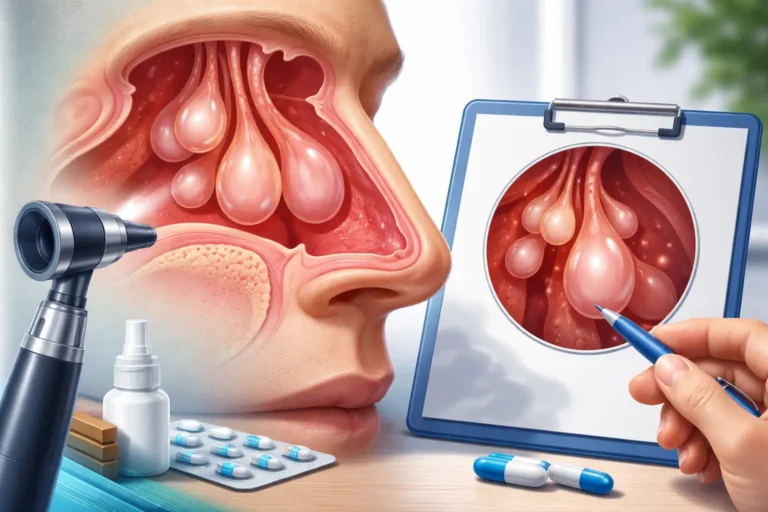
Next, he may suggest a nasal endoscopy. A thin camera is passed gently into your nose after a numbing spray. It takes a few minutes and is usually well tolerated. It lets the doctor see swelling, pus, polyps or a bent septum near the sinus openings. A healthy-looking nose, especially when seen during a headache, makes a sinus cause much less likely.
When a CT scan is useful
A CT scan shows the sinuses in detail, but not everyone needs one. It helps most when symptoms keep coming back or endoscopy is unclear. A scan done while you have symptoms tells more than one done when you feel well. Mild thickening of the sinus lining is also common in people with no sinus symptoms. So a scan must always be read alongside your story and the endoscopy findings.
Why a headache diary helps your diagnosis
Before your visit, try keeping a simple diary for two to four weeks. Note down:
- The date, time and how long each headache lasted
- Where the pain was and what it felt like (throbbing, pressing, dull)
- Any nose symptoms, and the colour of any mucus
- Possible triggers, such as sleep, stress, food, periods or weather
- Every medicine you took, and whether it helped
Patterns you miss day to day often stand out on paper.
Treatment once the cause is clear
Once the likely cause is clear, Dr. Jabbr will explain your options in plain words.
If the sinuses are the cause
When the pain is truly from the sinuses, treating the inflammation often eases the headache. A recent, short-lived infection is explained on our acute sinusitis treatment page. Long-standing swelling is covered on our chronic sinusitis treatment page. Care may include saline rinses, a steroid nasal spray, and antibiotics only when a bacterial infection is likely. If a deviated septum or another blockage plays a part, the doctor will discuss the next steps with you.
If it is migraine or tension headache
If your nose and sinuses look healthy, that is good news. With your doctor's advice, you may be able to stop treatments that were not helping, such as repeated antibiotics or long use of decongestant sprays. Dr. Jabbr will explain why migraine or tension headache seems more likely. He may advise you to see your family doctor or a neurologist. Migraine care can include avoiding triggers, regular sleep and meals, and medicines to stop or prevent attacks. Some people have both migraine and sinus disease, and then both need care.
For a wider overview of face pain linked to the nose, see our sinus headache specialist page.
Which headache warning signs need urgent care?
Most headaches are not dangerous. Get urgent medical help if you have:
- A sudden, very severe headache, like a thunderclap
- Headache with a stiff neck, high fever, confusion or a rash
- Swelling or redness around the eye, double vision or reduced vision
- New weakness, numbness or trouble speaking
- A headache after a head injury, or one that is new and keeps getting worse
Choosing a sinus headache doctor in Dubai
A good specialist will not simply prescribe more sprays. They will look inside your nose, match the findings with your symptoms and tell you honestly whether the sinuses are involved. Dr. Muhammad Jabbr, one of the best ENT specialists in Dubai for nose and sinus problems, brings that careful approach to every visit.
- MD, MS, DOHNS (England), European Board ORL-HNS and Arab Board ORL-HNS
- More than 20 years of ENT experience and more than 3,000 ENT procedures
- Sees both adults and children
- Rated 4.9 on Google from 406 reviews
Book an appointment
Dr. Muhammad Jabbr sees patients at the ENT Department, Medcare Hospital, Hadiqa Street, Al Safa 1, Dubai.
Book online with Dr. Muhammad Jabbr or call +971 52 751 7811.
Frequently Asked Questions
Can a sinus headache happen without a blocked or runny nose?
It is unusual. A true sinus headache nearly always comes with nose symptoms, such as blockage, thick mucus or a weaker sense of smell.
Why do my "sinus headaches" get better with migraine medicine?
If migraine tablets help, the headaches may well be migraines. Migraine can cause pressure over the face and a stuffy, watery nose, which is why it is often mistaken for sinus pain. Relief from one medicine does not prove the cause, so a doctor should confirm it with you.
Can a sinus CT scan show whether I have migraine?
No. Migraine does not show up on a scan. A CT scan shows whether the sinus lining is swollen or blocked. Clear sinuses on a scan taken during a bad spell suggest the sinuses are not the cause. Many people with headaches do not need a scan at all.
Can daily decongestant sprays make headaches worse?
Using decongestant sprays for more than a few days can cause rebound blockage, which may add to your discomfort. Taking painkillers on many days each month can also lead to more headaches. Talk to a doctor before using either for a long time.
Can children get sinus headaches or migraines?
Yes, both can happen in children. Migraine in children is often shorter than in adults, and some children feel sick or have tummy pain. In young children, the forehead sinuses are not fully formed yet. Dr. Muhammad Jabbr treats adults and children and can check whether the nose and sinuses are involved.
Conclusion
Not every headache over your face is a sinus headache. Many are migraine or tension headache. A careful history, a nasal endoscopy and, when needed, a CT scan can show the real cause. Then treatment has a better chance of working. For an honest answer about your headaches, Dr. Muhammad Jabbr is ready to help.