 By
Quick answer
Who performs sinus surgery in Dubai, and when is it needed?
Dr. Muhammad Jabbr is a Consultant ENT (ear, nose and throat) surgeon who performs sinus surgery at Medcare Hospital Al Safa, Dubai. Surgery is usually considered only after proper medicines have not helped enough. This often means two to three months of daily steroid nasal spray and saline rinses. Surgery may be worth discussing if two or more symptoms, such as a blocked nose and face pressure, last over 12 weeks. He can tell you if an operation would help.
You have used sprays, rinses and maybe several courses of antibiotics. Your nose still feels blocked, your face still aches, and the infections keep coming back. This is the point where a sinus surgery doctor in Dubai can tell you whether an operation would really help, and if so, which kind.
This guide is about the decision, not the operation itself: when surgery makes sense, and who each option suits.
Dr. Muhammad Jabbr is a Consultant ENT and Head & Neck Surgeon at Medcare Hospital, Al Safa, with more than 3,000 ENT procedures behind him. If you feel stuck after months of treatment, he can give you a plain answer about whether surgery is worth it.
When is sinus surgery needed after medicines fail?
Most sinus problems settle without an operation. Surgery usually comes up only after proper medical treatment has not brought enough relief. That often means two to three months of a daily steroid nasal spray and regular saline rinses. Some people also take a short course of tablets prescribed by their ENT doctor.
Surgery may be worth discussing if:
- Two or more symptoms, such as a blocked nose, thick discharge, facial pressure or a reduced sense of smell, have lasted more than 12 weeks.
- You have several separate sinus infections a year, and you feel well in between.
- A CT scan taken after treatment still shows blocked sinuses.
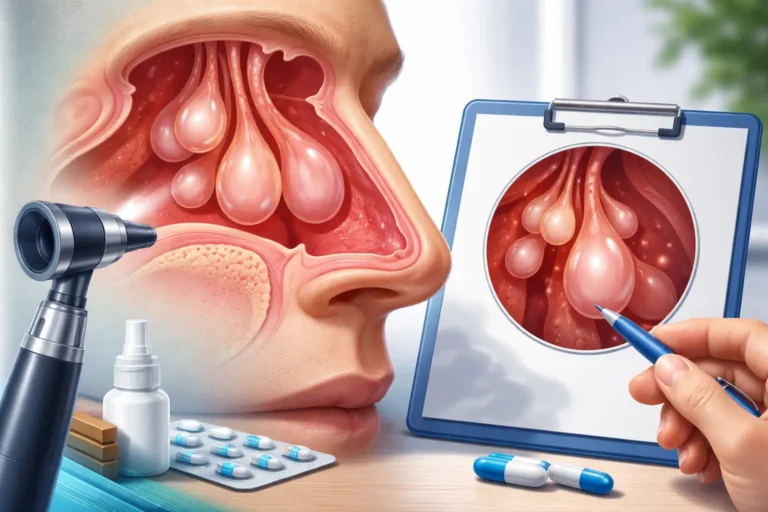
- Nasal polyps keep blocking your nose despite sprays.
- A less common problem is found, such as a fungal ball or a mucocele (a mucus-filled sac that slowly expands a sinus).
How does a sinus surgery doctor in Dubai decide if you need an operation?
The decision rests on three things: what you tell the doctor, what the camera shows, and what the scan shows.
Your history. Expect questions about the length of your symptoms, past treatments and what bothers you most. Asthma, allergies, aspirin sensitivity and earlier nose surgery can all change the plan.
Nasal endoscopy. A slim telescope looks inside your nose in the clinic. It can show polyps, pus, swollen lining or a septum that leans to one side.
CT scan of the sinuses. The scan maps the blocked sinuses and the bones around them. It is best done after a proper trial of medicines, not during a cold.
Not every face pain comes from the sinuses. Pressure without a blocked nose or discharge is often a form of migraine. If your endoscopy and scan are clear, a good surgeon will say that an operation is unlikely to help.
FESS or balloon sinuplasty: which one suits you?
These are the two main ways to open blocked sinuses. Both work from inside the nose, so there is normally no scar on the face.
FESS: the fuller option
Functional endoscopic sinus surgery (FESS) uses a slim telescope and small tools to clear blocking tissue and widen the natural openings. Several sinuses can be opened in one sitting, and polyps can be cleared during the same operation.
FESS is often the better fit when:
- Many sinuses are blocked, or disease is widespread on the scan.
- You have nasal polyps.
- The ethmoid sinuses, the small air cells between the eyes, are involved.
- A fungal ball or other trapped material has to be cleared.
Balloon sinuplasty: the smaller option
In balloon sinuplasty, a small balloon is guided into the narrow opening of a sinus and inflated briefly. This stretches the opening wider. Little or no tissue is removed, and many people recover faster than after FESS.
It may suit you when:
- Only one or a few sinuses are blocked, usually the maxillary (cheek), frontal (forehead) or sphenoid (deep behind the nose).
- There are no polyps, and the lining is not swollen throughout.
- You get repeated short infections with clear spells between them.
A balloon cannot remove polyps or diseased tissue, and it does not open the ethmoid cells. Some patients have both in one operation: FESS for some sinuses and a balloon for others.
When is image-guided sinus surgery used?
Your sinuses sit right next to the eye socket and the base of the skull, and the bone between them can be very thin.
In image-guided sinus surgery, your CT scan is loaded into a tracking system. During the operation, the screen shows where the tip of each instrument is on your scan images.
It is used most when:
- You have had sinus surgery before, so the usual landmarks have changed.
- The frontal or sphenoid sinuses need work, as they lie high or deep.
- Large polyps or long-standing disease have reshaped the bones.
It adds a second check in difficult areas. It does not replace the surgeon's knowledge of anatomy.
Where do steroid sinus implants fit in?
Steroid implants are small, flexible spacers placed in a sinus after it has been opened. Over the next few weeks, a steroid sinus implant releases a low dose of steroid onto the healing lining. Depending on the type, it dissolves or is taken out at a check-up.
One may be placed at the end of FESS to calm swelling and stop the new openings from scarring shut. Some types are also used when polyps grow back after earlier surgery. An implant works alongside your usual sprays, not instead of them.
Who might need revision sinus surgery?
Most people do well after a first operation, but for some, symptoms slowly return. Common reasons are scar tissue narrowing an opening, blocked cells left behind, or polyps growing back.
Another operation is not the first step. Your doctor will check your spray and rinse routine, and whether allergy or asthma needs better control. A fresh endoscopy and CT scan then show what has changed. If there is a clear blockage, revision sinus surgery may help, often with image guidance. When polyps keep returning despite surgery and medicines, injected medicines called biologics may also be an option.
Which sinus treatment suits which patient?
As a rough guide:
- Under 12 weeks, or medicines not tried properly: sprays and rinses first.
- One or two blocked sinuses, no polyps: balloon sinuplasty or a limited FESS.
- Many blocked sinuses, or polyps: FESS, sometimes with a steroid implant.
- Tricky anatomy, or frontal or sphenoid disease: FESS with image guidance.
- Symptoms back after earlier surgery: a medicine review, then revision surgery if a blockage is found.
- Facial pain with a clear scan and endoscopy: look for another cause.
Our page on choosing a sinus surgery specialist explains how these plans are made.
When do sinus problems need urgent care?
Sinus infections only rarely spread beyond the sinuses. When they do, it is an emergency. Go to hospital at once if you notice:
- A swollen, red eyelid, or an eye that bulges forward.
- Double vision, blurred sight, or eye pain when looking around.
- A bad headache along with neck stiffness, a high temperature, confusion or unusual sleepiness.
- A soft swelling over the forehead.
In children, these signs can appear within hours, so act quickly. Also arrange a prompt ENT visit if your symptoms affect one side only, especially with bleeding or a lump you can see in one nostril.
Why see Dr. Muhammad Jabbr for a sinus surgery decision?
Dr. Muhammad Jabbr holds MD, MS, DOHNS (England), the European Board ORL-HNS and the Arab Board ORL-HNS. He has more than 20 years of experience and sees adults and children at Medcare Hospital, Al Safa.
At your visit, you can go over your scan and hear which options fit your case, including when medicines are still the better path. He holds a 4.9 Google rating from 406 reviews and is among the best-qualified surgeons in Dubai to give a careful sinus surgery opinion.
Book an appointment
If medicines have not worked and you want a clear plan, make an online booking with Dr. Muhammad Jabbr or call +971 52 751 7811. Bring any earlier scans and a list of the medicines you have used.
Frequently Asked Questions
When is it too early to think about sinus surgery?
If you have not yet used a steroid spray and rinses correctly every day for two to three months, it is usually too early. Surgery may be discussed sooner if a complication or a growth is found.
Does balloon sinuplasty last as long as FESS?
In well-chosen patients with limited disease, the result can last well. But a balloon only stretches openings. It is not a good long-term choice when polyps or diseased tissue are present.
Will I still need nasal sprays after sinus surgery?
Often, yes. Surgery opens the drainage paths, but it does not change allergies or the tendency to form polyps. Afterwards, sprays and rinses reach the sinus lining more easily, which helps keep swelling down.
Is sinus surgery done in children?
Yes, but far less often than in adults. In children, large adenoids can cause very similar symptoms. These are usually checked first, and medicines or adenoid removal often help without sinus surgery.
Why do one-sided sinus symptoms need extra care?
Most sinus disease affects both sides. Blockage on one side only, especially with bleeding or a bad smell, is often harmless, but it can be a fungal ball, a polyp that needs testing or, rarely, a tumour. Surgery may be needed to clear the sinus and send tissue to the lab.
Choosing your next step
Sinus surgery is a set of tools, not one operation. Each option suits different people. If medicines have let you down, ask an experienced ENT surgeon to review your scan and symptoms, and choose the option that fits your sinuses.